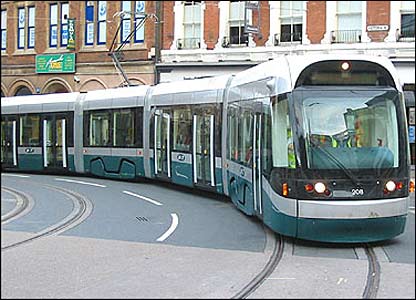
Introduction: a new age of light rapid transit
The numerous electric street tramway systems created during the late nineteenth and early twentieth centuries in the United Kingdom were gradually closed down by the 1950s and eventually replaced by buses, considered more flexible and cheaper. Only one such early system (in Blackpool) survives to this day and is being upgraded to modern standards.
Transport plans developed in the 1970s by the Passenger Transport Authorities following their empowerment by the 1968 Transport Act emphasised the need for major improvements to public transport. With heavy rail found to be prohibitively expensive, light rail transit was envisaged as a low cost alternative that could also be more seamlessly integrated into the urban fabric. With the help of significant Government contributions towards the cost of such public transport infrastructure projects, 7 light rail systems were opened between 1980 and 2004 for a total of 151 route miles. The private sector designed, constructed, operates and maintains most of the existing schemes.
As of November 2011, extensions to the Manchester system are under construction, upgrades to the Blackpool tram are nearly complete, modernisation of the Tyne and Wear Metro are beginning, and work is in progress on the Edinburgh tram line. While the Department for Transport (DfT) supports some of the financial burden of the construction, local bodies are expected to contribute as well as to bring in private sector funds.
Policy objectives
As a condition for DfT funding, light rail scheme applications must establish that they contribute to the government’s overall transport objectives. According to the Green light for light rail White Paper (DfT, 2011b), successful light rail systems stimulate economic growth and help reducing carbon, both key objectives of the current Coalition government. Similar objectives were already present in the previous White Paper, Delivering a sustainable transport system: a transport scheme is expected to support economic competitiveness and growth, tackle climate change by reducing emissions, contribute to better safety and health, promote equality of opportunity and improve the quality of life (DfT, 2008). Read the rest of this entry »
 Andru Tomoiu