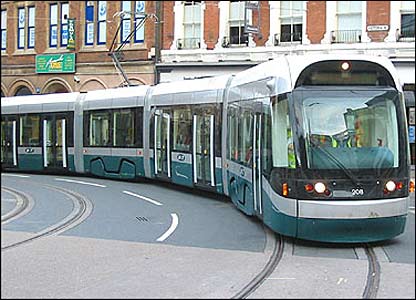
Introduction: a new age of light rapid transit
The numerous electric street tramway systems created during the late nineteenth and early twentieth centuries in the United Kingdom were gradually closed down by the 1950s and eventually replaced by buses, considered more flexible and cheaper. Only one such early system (in Blackpool) survives to this day and is being upgraded to modern standards.
Transport plans developed in the 1970s by the Passenger Transport Authorities following their empowerment by the 1968 Transport Act emphasised the need for major improvements to public transport. With heavy rail found to be prohibitively expensive, light rail transit was envisaged as a low cost alternative that could also be more seamlessly integrated into the urban fabric. With the help of significant Government contributions towards the cost of such public transport infrastructure projects, 7 light rail systems were opened between 1980 and 2004 for a total of 151 route miles. The private sector designed, constructed, operates and maintains most of the existing schemes.
As of November 2011, extensions to the Manchester system are under construction, upgrades to the Blackpool tram are nearly complete, modernisation of the Tyne and Wear Metro are beginning, and work is in progress on the Edinburgh tram line. While the Department for Transport (DfT) supports some of the financial burden of the construction, local bodies are expected to contribute as well as to bring in private sector funds.
Policy objectives
As a condition for DfT funding, light rail scheme applications must establish that they contribute to the government’s overall transport objectives. According to the Green light for light rail White Paper (DfT, 2011b), successful light rail systems stimulate economic growth and help reducing carbon, both key objectives of the current Coalition government. Similar objectives were already present in the previous White Paper, Delivering a sustainable transport system: a transport scheme is expected to support economic competitiveness and growth, tackle climate change by reducing emissions, contribute to better safety and health, promote equality of opportunity and improve the quality of life (DfT, 2008).
In Greater London, Transport for London (TfL) is currently responsible for the development and funding of new light rail schemes. TfL implements the Mayor of London’s Transport Strategy and manages transport services, including the Docklands Light Railway (DLR) and the Croydon Tramlink. The latest Mayor’s Transport Strategy published in May 2010 sets six goals for the London transport system: support economic development and population growth, enhance the quality of life, improve the safety and security, improve transport opportunities, reduce transport’s contribution to climate change and, more pragmatically, support delivery of the London 2012 Olympic Games (GLA, 2010).
Responsibility for transport in the UK outside England has been transferred to the devolved administrations. As such the DfT does not have any direct dealings with light rail schemes outside England. Scotland’s current National Transport Strategy defines three strategic outcomes setting the context for their transport policy making: improve journey time and connections, reduce emissions, and improve quality, accessibility and affordability (Scottish-Executive, 2006).
More broadly, in its 2007 Scottish Budget Spending Review the Scottish Government introduced the National Performance Framework, a benchmark against which the government’s agenda delivery can be measured (Scottish-Government, 2007). Outcomes such as economic growth, participation and sustainability are areas in which public transport can play a significant role, and is expected to do so. National indicators and targets such as reducing the proportion of driver journeys delayed due to traffic congestion and increasing the proportion of journeys to work made by public or active transport echo the objectives of the National Transport Strategy.
It is thus apparent that similar overall objectives have been set by the different UK administrations involved in light rapid transit planning.
Carbon reduction
A key provision of the Climate Change Act 2008 is a national legally binding target of at least an 80% cut in greenhouse gas emissions to be achieved by 2050. Domestic transport accounts for 21% of the United Kingdom’s total CO2 emissions, and more than half of these are from the private car (DfT, 2011a). The Local Transport White Paper on cutting carbon in transports published in January 2011 (DfT, 2011a) suggests that approximately one third of emissions are generated by car trips under ten miles, where are the biggest opportunities to change way people travel by offering more sustainable choices, such as public transit.
Economic growth
Quality transport providing access to housing, retail, workplaces and services is essential for the economic vitality of cities. Conversely, traffic congestion due to the growth of car use reduces the economic potential of affected urban areas. Light rail providing high capacity transport through the heart of major conurbations helps supporting economic growth and encourages regeneration of declining areas. The permanence of a light rail scheme encourages businesses to develop along the route, and provides visible evidence that an area is being invested in (NAO, 2004). The benefits of urban regeneration brought by permanent public transit systems include job creation and increased tax revenue.
Modal shift
The permanence of a light rail system and the associated traffic management measures are associated for the passengers with availability, predictability and reliability (PTEG, 2005). The fixed route of a light rail system is also easier to understand for public transit users. It also acts as an incentive for businesses to develop along the light rail routes, which in turn concentrates development and results in a more effective transport service. These factors help to generate a significant modal shift from car for rapid transit schemes in the UK (NAO, 2004).
Setbacks and issues: finding the right track
The overall trend of light rail usage in the UK is positive, as most systems have shown moderate patronage growth year over year (DfT, 2011b). Occasion shortfalls are due to various factors including early operational issues, direct bus competition after the deregulation and over-optimistic forecasting.
Many recent reports have pointed out some of the issues that hamper the wider acceptance of light rail schemes as valid solutions for urban congestion problems. Importantly, light rail is not seen as an affordable option for local transport authorities (DfT, 2011b; NAO, 2004). This is due to high start-up costs caused by the fixed infrastructure requirements, and frequent capital cost over-runs.
On the other hand, groups such as the Light Rapid Transit Forum argue that the current legislation and policy are also hindering the progress of new schemes (LRTF, 2009). Among a number of issues are mentioned the lengthy planning and approvals system, a bias against light rail schemes in appraisal and funding rules favouring bus and road schemes, the absence of a robust policy on quantifying the environmental benefits of urban public transport schemes, and government funding commitments subject to sudden changes of direction.
Undeniably, recent practice in light rail scheme delivery in the UK has a mixed track record. Most notably the setbacks of the Edinburgh tram scheme have been the focus of considerable public attention. Not only was the public discontent with the lengthy utility works, but the escalating budget over-runs leading to disputes between the promoters and the contractors weakened public and government support for the scheme, and ultimately endangered the completion of the scheme as initially proposed.
Comparing the current UK delivery to other Western European schemes, it will be seen that some of the same issues have been dealt with effectively by European light rail promoters.
The tram system in Strasbourg, France, is a good example of successful delivery. From the start there was strong political backing for the scheme, with the Strasbourg Mayor fully committed to the project. The line was built as part of a general refurbishment of the public transport system, which has allowed a large part of the city to become a free from through traffic. Moreover, multiple park-and-ride facilities were provided around the edge of the inner city. As was the case in Edinburgh, local retailers complained about a loss of 30% of their turnover during the construction works. The local authority increased the number of car parking spaces, which helped the turnover to fully recover. Surveys indicate that the quality of life, the price of homes along the tram route and the overall economic prosperity of the area have all improved significantly (PTEG, 2005).
The LRTF paper lists some of the major aspects that help driving the non-UK European light rail schemes. More local decision making and tax raising, economies of scale associated with bulk or standardised procurements, more coherent integration of transit schemes with land use and economic development, and better integration of other transit systems such as heavy rail and bus (LRTF, 2009).
A key point is that in other European counties, light rails schemes are promoted as complete projects delivering transport solutions but also urban renewal, social development and social cohesion.
Current policy: actions and recommendations
The 2011 White Paper Green light for light rail (DfT, 2011b) is the most recent policy, and identifies some of the principal barriers to light rail investment:
– Inefficiencies due to diverging industry standards
– Over-specification of the schemes
– Promoter capability
– Limited local sources of finance
– Costs of utilities and diversionary works
– Timescales for authorising light rail schemes
According to this report, the solution to the financial difficulty of promoting a new light rail scheme is to look for less expensive ways of doing things. Recommendations include some of the solutions adopted in other European countries: standardisation of designs, creating a centre of procurement excellence, seeking of alternatives to light rail (train-tram, ultra light rail for instance). Notably, the government proposes to allow councils to use Tax Increment Finacing to borrow against projected rate growth in order to finance infrastructure developments, which would reduce the dependence of promoters on the DfT for funding.
The ideas raised by the new policy are sound, and their application will hopefully help reduce the financial burden on new light rail scheme promoters. However, the course of action to actually achieve the economies promised by the White Paper recommendations is not straightforward. The development of standard designs of light rails systems, research on integration and the improvement of the existing procurement methodology is a lengthy process.
Light rail, trams and other rapid transit systems can play a major role in improving the attractiveness and quality of public transport. Not only is this mode of transport favourable for passengers but also for local economies. However, the means to achieve the ends are not yet all present in the current transport UK policies. Solutions borrowed from other European countries could help the light rail promoters successfully deliver their schemes. Clear taxation raising powers to local authorities, a clear national policy encouraging light rails schemes where they are appropriate, and stronger government involvement with industry partners in order to establish more efficient and less expensive delivery methods would help bring the UK light rapid transit development in line with its European counterparts.
References
DfT (2008) ‘Delivering a Sustainable Transport System’, Department for Transport, London.
DfT (2011a) ‘Creating Growth, Cutting Carbon’, Department for Transport, London.
DfT (2011b) ‘Green light for light rail’, Department for Transport, London.
GLA (2010) ‘Mayor’s Transport Strategy’, Greater London Authority, London.
LRTF (2009) ‘Submission of the Light Rapid Transit Forum (LRTF) to APPLRG/pteg inquiry into light rail’, Light Rapid Transit Forum.
NAO (2004) ‘Improving public transport in England through light rail’, National Audit Office, London.
PTEG (2005) ‘What light rail can do for cities – A review of the evidence’, Steer Davies Gleave, London.
Scottish-Executive (2006) ‘Scotland’s National Transport Strategy’, Scottish Executive, Edinburgh.
Scottish-Government (2007) ‘Scottish Budget Spending Review’, Scottish Government, Edinburgh.
 Andru Tomoiu